
what is SEO
In today’s digital world, simply having a website is not enough. If your audience cannot find you online, your business is missing out on valuable opportunities. That’s why understanding what is SEO and how it works is essential for growing your online presence.
SEO, or Search Engine Optimization, helps your website rank higher on search engines like Google, making it easier for potential customers to discover your brand organically.
If you’re wondering what is SEO and how it works, it is the process of optimizing your website to improve its visibility in search engine results. The main goal is to increase organic (non-paid) traffic by making your website more relevant, user-friendly, and trustworthy for both users and search engines.
How SEO works
1. SEO (Search Engine Optimization):
The process of optimizing a website or online content to increase its visibility in search engine results, thereby attracting more organic (non-paid) traffic.
2. Keywords:
Words or phrases that users enter into search engines. Optimizing content around relevant keywords helps search engines understand the topic and rank the content appropriately.
3. On-Page SEO:
Optimization techniques performed directly on the website, such as improving content quality, using proper headings, optimizing images, and enhancing meta tags (title and description).
4. Off-Page SEO:
Actions taken outside of your own website to impact your rankings within search engine results pages (SERPs)—primarily building backlinks from other reputable websites.
5. Backlink:
A hyperlink from one website to another. Quality backlinks from authoritative sites are a significant ranking factor for search engines.
6. SERP (Search Engine Results Page):
The page displayed by a search engine in response to a user’s query, showing a list of relevant results.
7. Meta Tags:
HTML tags that provide information about a web page to search engines and users. The most important are the title tag and meta description.
8. Organic Traffic:
Visitors who land on your website as a result of unpaid (organic) search results.
9. Crawling:
The process by which search engines use bots to systematically browse the internet and discover new or updated pages.
10. Indexing:
Once a page is crawled, search engines add it to their database (index) so it can be shown in search results.
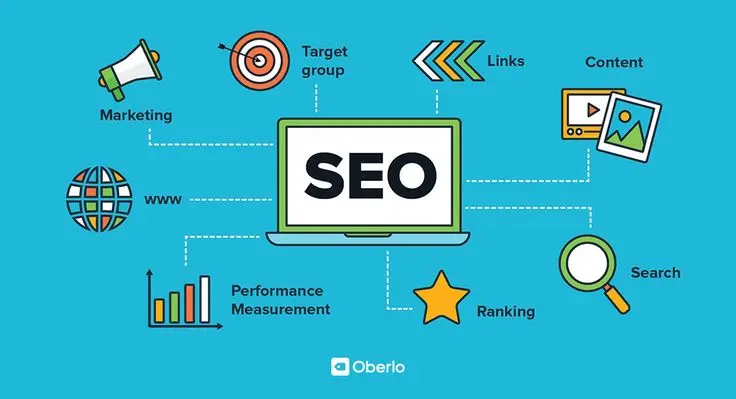
This image is a comprehensive visual breakdown of Search Engine Optimization (SEO), showing how multiple digital marketing components connect to improve a website’s visibility, traffic, and ranking on search engines.
At the center is a laptop displaying “SEO,” symbolizing that all activities—content creation, marketing, analytics, and linking—are managed digitally through websites and online platforms. SEO is the core system that integrates all these elements to make a website perform better on search engines.
What is SEO and How It Works: Key Elements Explained
Marketing
This represents the promotion aspect of SEO. It includes:
Social media marketing
Paid ads (Google Ads, Meta Ads)
Email campaigns suggest a heading for this content Marketing helps drive initial traffic and awareness, which indirectly supports SEO by increasing engagement and visibility.
Target Group
SEO is not just about traffic—it’s about attracting the right audience. This includes:
Identifying customer needs
Keyword research based on user intent
Creating content that solves specific problems
Reaching the correct target group increases conversions and reduces bounce rate.
Links
Links are one of the most important ranking factors in SEO:
Backlinks: Links from other websites that improve credibility
Internal links: Connecting pages within your own site
Strong link-building signals trust and authority to search engines.